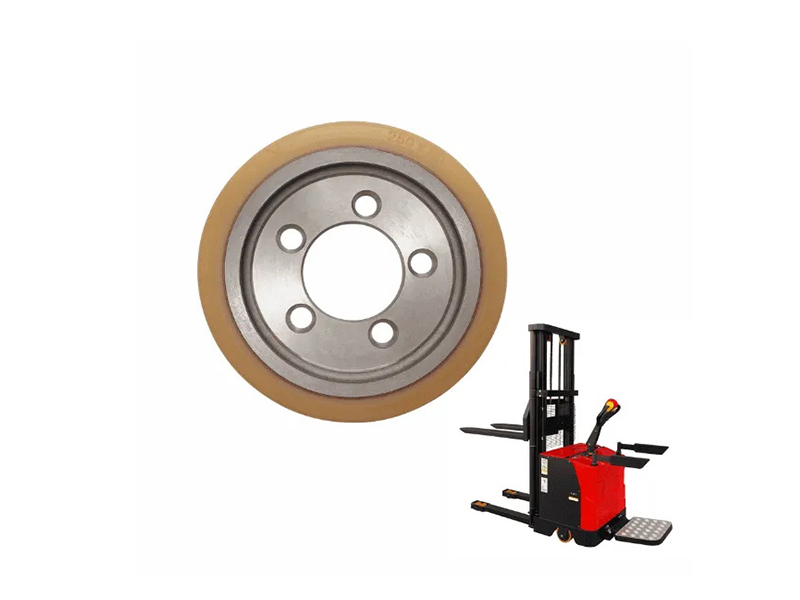
Understanding Electric Stacker Drive Wheels and PU Material Advantages
The drive wheel is the single point where an electric stacker converts motor torque into motion, making its material composition a make-or-break engineering decision. Polyurethane (PU) consistently outperforms rubber and nylon in demanding warehouse environments, but the argument for PU is not without its counterpoints. Rubber offers superior grip on wet concrete, yet it wears rapidly under heavy cyclic loads and leaves scuff marks that facility managers despise. Nylon, meanwhile, resists compression beautifully but transmits vibration directly to the drivetrain and floors, accelerating component fatigue. PU strikes a balance: it delivers high load-bearing capacity, resists abrasion, and protects both the wheel and the floor surface.
For the vast majority of indoor warehousing operations—where temperatures stay between 5°C and 40°C—custom PU drive wheels deliver the longest service life per dollar spent. The material's hardness can be tuned from 70 Shore A to 95 Shore A, allowing engineers to match traction needs against rolling resistance. This tunability is precisely why off-the-shelf wheels often disappoint: they are compromises, whereas custom PU wheels are engineered solutions.
Key Specifications for Custom PU Drive Wheels
Ordering a custom PU drive wheel without a complete specification sheet is a recipe for costly returns. The most consequential parameters are wheel diameter, tread width, bore diameter, keyway dimensions, and PU hardness. A deviation of even 2 mm in bore diameter can cause wobbling, uneven wear, and premature bearing failure—yet buyers routinely overlook this dimension when prioritizing load capacity. Load capacity ratings must account for dynamic forces, not just static weight; a 2,000 kg static load can spike to 3,500 kg during emergency braking or travel over uneven expansion joints.
Beyond dimensions, engineers must specify the PU compound's formulation. Ester-based PU resists oils and solvents but hydrolyzes in humid conditions. Ether-based PU handles moisture far better but costs 15–25% more. Hub material matters equally: cast iron hubs absorb vibration and resist deformation, while aluminum hubs reduce unsprung weight but can crack under shock loads. The table below summarizes typical specification ranges for PU Drive Wheel for Electric Stacker across common capacity classes.
| Capacity Class | Wheel Diameter (mm) | Tread Width (mm) | PU Hardness (Shore A) | Typical Hub Material |
|---|---|---|---|---|
| 1.0–1.5 t | 200–250 | 60–80 | 80–88 | Cast iron |
| 1.5–2.5 t | 250–300 | 80–100 | 85–92 | Cast iron |
| 2.5–3.5 t | 300–350 | 100–120 | 88–95 | Cast iron / Steel |
| 3.5–5.0 t | 350–400 | 120–150 | 90–95 | Forged steel |
The Customization Process with an OEM Manufacturer
Working directly with an OEM manufacturer compresses the supply chain and typically cuts unit costs by 20–40% compared to aftermarket distributors.
The process begins with a technical drawing or a physical sample. Reputable OEMs will reverse-engineer worn wheels and propose material upgrades, not merely replicate the original. This proactive engineering is where the real value lies—a supplier who simply copies a competitor's wheel without analyzing failure modes is a order-taker, not a partner.
Prototyping follows, usually within 15–25 days . A proper OEM will run dynamic load tests, hardness verification, and bond-strength checks between the PU tread and the hub. Once the prototype passes, production runs typically take 20–35 days depending on mold availability and order volume.Factors Influencing OEM Manufacturer Pricing
Pricing for custom PU drive wheels is not a simple function of size. Mold costs dominate small orders, often adding $800–$3,000 to the first production run. This is why unit prices collapse as order quantities rise: the mold expense is amortized across more units. A buyer ordering 10 wheels might pay $180 each, while a buyer ordering 500 could pay $65–$90 for the identical specification. Suppliers rarely volunteer this math, so buyers must calculate the amortization themselves to negotiate effectively.
Material selection creates another pricing tier. Ether-based PU, anti-static compounds, and flame-retardant formulations each add 10–30% to material costs. Hub machining complexity matters too: a keyway and snap-ring groove add machining time, while a simple press-fit bore does not. Geographic location also skews pricing dramatically.
How to Choose the Right OEM Supplier
Certifications are a starting point, not a verdict. ISO 9001 tells you the factory has a quality management system, but it does not guarantee the system produces wheels that survive 10,000 hours of stacker operation. You should request documentation regarding failure modes as well as customer references from similar industries. A supplier who serves automotive assembly plants faces different quality pressures than one serving small logistics depots.